

Learn how to build and maintain a brand that makes your company well-known, adored, and preferred.
Coke is more than just a soda. Coffee is only one aspect of Starbucks. Beyond computers, Apple is a brand.
We purchase these brands with an eye on the experiences they offer. And these businesses are fully aware of the experience they want you to have when you buy (or consider buying). They cultivate their brands for this reason.
Free Brand Building Guide: Download Now
This branding guide will assist you in developing and maintaining a powerful brand that will inspire clients to respect, recall, and favor your company. To find what you need, continue reading or use the buttons below to skip ahead.
Learn how to build and maintain a brand that makes your company well-known, adored, and preferred.
1
What is branding?
2
The Value branding?
3
Branding Terms to know
4
How to create a brand
5
Branding tips

What is a brand?
A brand is a company’s identity and narrative that distinguishes it from rival businesses that offer comparable goods or services.
Companies may easily express their vision through their brands. A company’s brand makes it clear what it stands for and why. A brand also describes the overall experience a customer has while interacting with a business, whether they are doing so as a customer, follower on social media, shopper, or casual bystander.
What is branding?
There are two definitions of branding. First, branding is the process of establishing a company’s identity. Second, branding refers to the elements that support a brand, such as a logo, tagline,, or voice.
In other words, branding is the process of learning, creating, and implementing a unique feature or collection of features for your business so that customers can start to link it with your goods or services.
Social media captions, color schemes for billboards, and the materials firms use for their packaging are all examples of branding. Businesses that build powerful brands are aware that their brand identity must exist everywhere. They are aware that their brands have power that goes far beyond the label and can influence consumers to pick their goods from a variety of alternatives.
One of the most famous logos and color schemes in the world, for instance, belongs to the Coca-Cola company. Over a century has passed since the inception of the iconic red and white writing, eye-catching artwork, and distinctive font.

The Coca-Cola brand has endured through the years and is proof of the effectiveness of persistent, well-loved branding.
Having said that, branding is an iterative process that necessitates connecting with the soul of both your customers and your company.
Marketing Vs. Branding
Although branding and marketing are sometimes combined into a single focus or idea, they are actually quite different. In terms of priorities, branding and marketing are frequently contrasted. In actuality, both of them are crucial to a flourishing company and must cooperate for one to expand.
Simply put, marketing is the tactics and strategies used to express a company’s vision, whereas branding is the company’s identity.
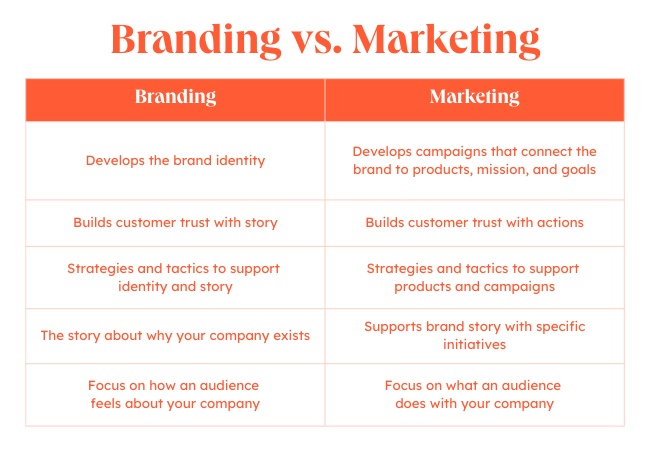
Although branding and marketing are sometimes combined into a single focus or idea, they are actually quite different. In terms of priorities, branding and marketing are frequently contrasted. In actuality, both of them are crucial to a flourishing company and must cooperate for one to expand.
Simply put, marketing is the tactics and strategies used to express a company’s vision, whereas branding is the company’s identity.
Why is it important to brand
One of the most valuable assets of your company is likely your brand. It offers your company a distinct identity, establishes your company as memorable, inspires customers to make purchases from you, supports your marketing and advertising efforts, and instills pride in your staff.
Additional advantages of branding include:
1. Directs purchasing choices.
When people decide what to buy, branding may be the decisive factor. In fact, according to a 2021 Razorfish report, 82% of questioned consumers choose to support companies that have a higher purpose or mission. 67% of consumers claim that the companies they shop from improve them as people.
2. Establishes a brand for your company.
Branding provides your company a personality. Beyond a company’s goods or services, a brand exists. It provides customers with a point of connection and relatability.
3. Aids clients in remembering your company.
Branding helps people remember your company. It serves as the public face of your firm and aids consumers in recognizing you in all media.
4. Encourages marketing and advertising.
Your marketing and advertising efforts are supported by your brand. Your promotion will have more effect and recognition as a result.
5. Encourages worker support.
Developing a brand makes your staff proud. When you brand your firm, you’re building a trustworthy, well-respected workplace in addition to giving it a unique personality. Strong employees are attracted by strong branding.
How to create a beautiful brand
- Decide who your target market is.
- Create a mission statement.
- Define your principles, attributes, and advantages.
- Make your visual resources.
- Find the voice of your brand.
- Promote your company.
Here’s how to establish your brand or start the process of rebranding your company.
Building a successful brand involves many factors, all of which must be taken into account. So, take out a notebook and make notes while you read this part. Recognize that the process of branding is iterative. This implies that as you develop your brand and brainstorm, you might find yourself repeating some of these procedures.
Want to create a measurable, successful brand? Download our free brand-building guide now.
1. Decide who your target market is.
Awareness, recognition, trust, and money are all results of branding. We’ve already discussed it. Let’s take a step back, though, and consider where those come from: the consumers. Not just any customers, either – yours.
customers and the intended audience. Respondents desire a personalized experience, according to 70% of consumers. However, how can you provide that experience if you don’t know who they are?
Your brand won’t generate visibility, recognition, trust, or money if it doesn’t connect with your audience. Target market research can help with that.
You must be aware of your target audience before putting pen to paper (or cursor to digital document). Who is your product intended for? Who is the perfect client for you? Why did you initially start your business?
Make this phase your top priority because what you discover about your target market and customer personas will affect your branding choices later on.
To streamline your target audience research and improve your marketing, use our free Persona Templates.
2. Identify your purpose statement
Let’s go back to the query I posed in the last section: Why did you start your company? By responding to this, you can create your mission statement. This statement expresses the organization’s passion and goal.
You must be able to demonstrate the value that your company offers before you can create a brand that your target market respects and believes in. Then, that goal and vision may be reflected in every aspect of your brand, including your logo, tagline, images, voice, and personality.
Your brand manifesto’s foundation is made up of your purpose statement. It covers the reasons for your company’s existence as well as the importance of your brand to consumers.
3. Describe your special traits, virtues, and advantages.
In your sector and niche, there are undoubtedly many companies. It’s simple to concentrate on your competitors (and there is a time and place for competitive analysis), but let’s concentrate on you for the time being.
What one feature does your company have that no one else can legally imitate? your name.
Because of this, you must make sure that your brand is created from and motivated by factors that are entirely unique to you: the principles, advantages, and characteristics that make your business special.
Make a list of the things that make your company unique in the time you have. I’m not referring to features of products (like appearance, components, or capabilities). Regarding how your goods or services are presented, increase success and quality of life.
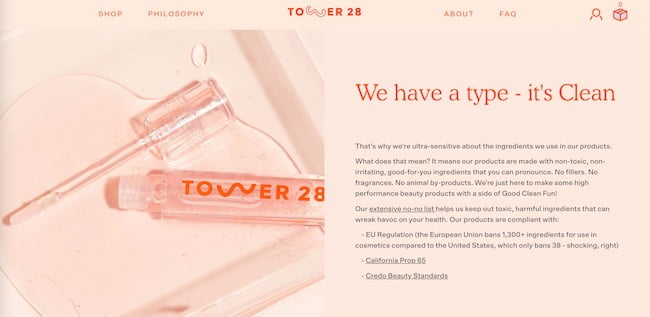
“Tower 28 Beauty is an example of a real brand.”
You may be familiar with Tower 28, a beauty brand that gained popularity on TikTok in 2021. Because they avoid using dangerous components and because I appreciate and trust the company (plus, their products are attractive), I buy their skincare products. Their distinct beliefs and advantages as a component of their overall brand are succinctly and simply described on their website. Customers like me find it simple to trust their products and pick them over rivals as a result.
4. Produce your graphic materials.
You should now be aware of your target market, your goal statement, and the distinctive features that make up your company.
Are you certain that you’ve completed these steps? If the answer is affirmative, it’s time to proceed to the graphic design, one of the more fascinating aspects of branding. We’re referring to your brand’s iconography, color scheme, typography (fonts), and other visual elements.
5. Discover your company’s voice.
Next, think about your brand’s voice. What would your brand say to you if you texted it or had a discussion with it?
A component of your branding is also how you interact with your target audience. Your audience has to feel connected to and engaged by your brand voice in order for them to pay attention. As a result, don’t be afraid to go back to step one to familiarize yourself with your audience.
Your tone needs to be constant throughout your brand story, blog posts, Instagram captions, and advertising efforts.
6. Make use of your branding.
Only if you do will your brand succeed. After finishing the design and creation of your new brand (or rebrand), incorporate it into every aspect of your company. Make extra sure that it is visible anyplace that your company interacts with clients. Here are some pointers for implementing your brand across your entire company.
Website
50% of people believe that a company’s brand depends on its website design. Therefore, use your logo, color scheme, and font liberally throughout your website. Use only the assets you’ve already identified in your brand standards.
Your website plays a significant role in the identification of your business; if it doesn’t represent your brand, customers will only have an unsettling encounter. Additionally, make sure that all calls to action, product descriptions, and site copy reflect your brand voice.
Packaging
The most obvious method that customers interact with your brand when you sell physical goods is generally through your product. Because of this, your packaging should emphasize your new branding in terms of its layout, hues, size, and texture.
Example of a Real-World Brand: Chobani
I adore Chobani yogurt—in fact, I’m currently eating some. My first impression of their branding is that they make genuine, wholesome Greek yogurt. One of the main reasons I purchase Chobani is for that. It intentionally chooses to use recyclable paper cups to package their yogurt, supporting the overall experience they’ve associated with buying and consuming the Chobani brand.
Social Media
According to study from 2022, social marketers’ #1 priority is raising brand awareness. Your brand should be reflected in all profile pictures, cover art, and other branded material. Think about making your profile photo your brand. Customers will find it simpler to distinguish your company as a result. Make sure your brand voice is there in all profile information, posts, and captions, just like it is on your website.
Branding True Advertising
Digital and print advertisements are frequently used to build brand awareness and introduce consumers to your brand. In fact, 33% of marketers utilize paid advertisements to raise brand awareness, according to HubSpot data.
It’s crucial that they present your branding as a result. In reality, your branding should facilitate the development of ads. You already know how your advertisements should look and what kind of material to produce according to your brand style guide.
Branding Terms
You should be aware of the following other brand-related buzzwords. They demonstrate the significance and benefit of business branding.
Brand Trust.
The level of consumer and customer trust in your brand is referred to as brand trust. Do you keep the promises you make in your marketing? Do you offer exceptional customer service and sales? These actions can build customer trust, which is crucial in a society when only 14% of people have faith in major corporations.
👉🏼 A strong brand helps you win your clients’ trust.
Brand Recognition.
Brand recognition refers to how well a consumer (preferably in your target market) can recognize and identify your brand through your logo, tagline, jingle, packaging, or advertising without first seeing your company name. This idea is related to brand recall, which is the capacity to recall a brand without any visual or audible cues.
Strong branding helps people remember your company.
Brand Valuation.
The commercial value of your brand is determined by how consumers perceive, recognize, and trust it. This idea and brand equity go hand in hand. A strong brand may make your company priceless to shareholders, investors, and potential customers.
Your company’s value will improve with strong branding.
Brand Management.
Brand management is the procedure for developing and preserving your brand. Both the tangible (style manual, packaging, color palette) and intangible (how it is viewed by your target market and client base) aspects of your brand must be managed. Your brand should be treated as though it were a living, breathing asset.
Strong branding necessitates ongoing maintenance.
Brand Identity.
Your company’s personality and the promise you offer to your clients are expressed through your brand identity. It’s the impression you want your customers to have of your brand after they interact with it. Your brand identity is often made up of your values, the way you market your goods or services, and the emotions you want customers to have when they use it.
A strong brand extends beyond your company’s name.
Brand Awareness.
Brand awareness is the measure of how well-known your company is among your target market and the wider public. Brands with a high level of brand awareness are described as “trending,” “buzzworthy,” or “popular.” Because people cannot contemplate buying from your brand if they are unaware of it, brand awareness is crucial.
👉🏼 Strong branding helps people recognize your company.

Customer Service And Sales
A brand is only as strong as the people who support it, therefore if your team isn’t working to make your brand effective, it won’t work for you. Additionally, your brand extends beyond your marketing.
Your brand principles should be communicated to your sales and customer service staff, and they should be followed especially when they interact directly with customers. Encourage them to incorporate your logo, tagline, iconography, and brand language whether they’re answering consumer queries or delivering a demo of a branded product.
Branding tips
- Consider your brand to be a person.
- Put consistency first.
- Make a branding strategi.
- Keep your inspiration from becoming a copy.
- Hire by branding.
Consider your brand to be a person.
Consider your brand as a person to better understand the branding process. Your brand should have a distinct identity, a distinct personality, and a distinct experience that people will remember.
Consider these inquiries regarding your brand:
- What would your company say about itself?
- How would it characterize its appearance if forced to?
- How would your company describe the goods or services you offer?
- Would it be lighthearted and edgy or would it be serious and professional?
- What would a person think of your brand after first “meeting” it? What would they say about it in a few sentences?
Developing relationships with your clients is the aim of branding. Treating your brand like a real person and realizing that you want your customers to do the same is the simplest approach to achieve this.
Put Consistency First.
Consumers who support brands are looking for authenticity from those brands in 88% of cases. Because it fosters customer confidence and demonstrates to them the authenticity of your ideals, consistency is crucial for branding. Without it, you run the risk of unintentionally confusing your customers and undermining your brand.
Consistency is a focus for valuable, recognizable companies, and they profit from it. Create a consistent brand presence across all platforms and media. This makes it simple for clients to become accustomed to, recognize, and eventually prefer your brand. This effort can benefit from brand standards.
Make A Branding Strategi
Your brand rules are only one aspect of a brand strategy. It is a strategy with clear, long-term objectives that your team can accomplish as your brand develops. These objectives often center on the meaning, feeling, adaptability, competitive awareness, and employee engagement of your brand.
Recall how I said that building a brand is an ongoing process? There are several factors involved. Your brand will continue to advance toward success and recognition if you use a brand strategy to transform that process into a well-oiled routine.
Keep Your Inspiration From Becoming A Copy.
Competition research is crucial. It not only informs you of the strengths and weaknesses of your rivals, but it may also inspire you with suggestions on how to strengthen or further distinguish your brand.
However, take caution not to fall into a copycat trap. Limit your competitive research and concentrate on the strengths of your company. You don’t have to brand your business the same manner that a competitor (or two) have done just because they have done it. Innovative, original, and daring brands stand out.
Hire By Branding
Strong branding inspires pride in your staff. I am happy to be a member of HubSpot. Utilize your brand to draw in outstanding individuals. If your company places a high priority on hiring, invest some time and money on employer branding.
Employer branding is the process of promoting your business to potential employees and current ones. Others will share your pride in your company if you are willing to show it.